|
I have been making art work for over half my life - the better half. Soon after college I started making gold and silver enameled jewelry, but I eventually moved to other art forms due to the small area available for decoration and expression. I began making and painting large porcelain and stoneware plates, platters and tiles, and started enjoying art again due to the much larger area to work with. I took numerous classes and workshops to improve my craft, and worked for a number of years painting in colored porcelain slip (liquid clay).
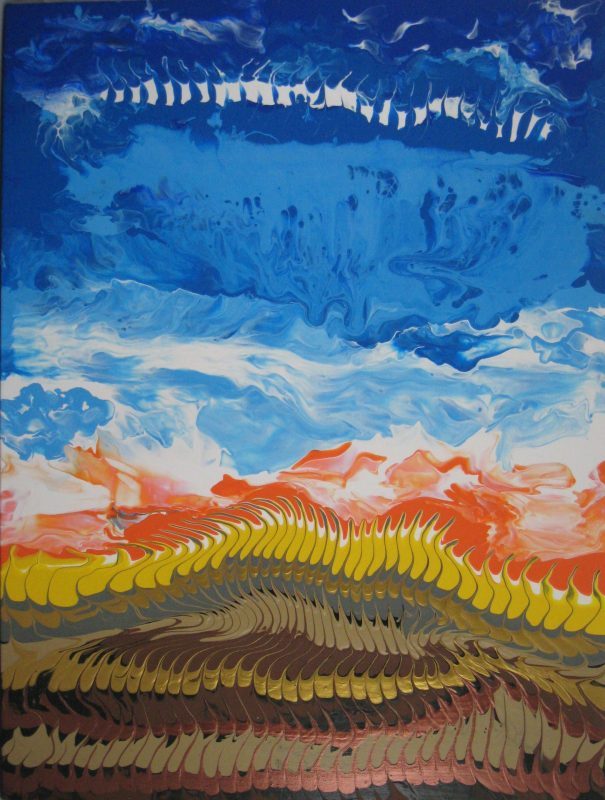
Some of the main inspirations for my art come from the textures, shapes and colors found in rocks, minerals and geologic formations. I was born and raised in Pasadena, California, close to many rock collecting areas. I spent many family weekends and summer vacations in the Mojave Desert and Southern California mountains collecting rocks and minerals, and looking for gold specimens. I was always fascinated by the many swirling and crackle patterns in the various rocks, especially the marbles, shales and slates. Similar marbled patterns can be seen in many of my landscape and seascape acrylic paintings.
Growing up in Southern California gave me a chance to visit many of the area museums including The Natural History Museum of Los Angeles County with its Gem & Mineral Hall. I also spent many happy hours at the San Bernardino County Museum. Spending so much of my time exploring old mines and looking for minerals, (especially gold) I guess that it is no surprise that I eventually earned a Bachelor of Science Degree in Geology at the University of California, Riverside.
I started taking ceramics classes in 1987 at the Walnut Creek Civic Arts Clay Studio in California. I took most of the classes and workshops offered there, and I was most interested in glazing and slip decoration. It was at this time that I started to concentrate on clay marbling and slip on-lay techniques using wax resist. Always looking for new art techniques, I took classes from many of the instructors, including Andree Thompson, Skip Esquierdo and Pete Coussoulis, Ceramics Studio Manager and Kiln Master. Additional classes and workshops taken include: Working with Paper Clay with Graham Hay; Clay Monoprinting with Diana Crain; and Clay Sculpture with Tony Natsoulas.
Marbled designs have always fascinated me. Growing up, we had several old atlases that had paper marbling in the book lining. I think I spent more time looking at the book jackets than the maps inside. Years later, I took a paper marbling class in Walnut Creek, CA, and I enjoyed sending out marbled designed greeting cards to friends and relatives until I ran out of that beautiful paper. I had already started ceramics classes then, so this is when I began my experiments with slip marbling and decorating. Then, as today, very few artists used marbling techniques, and very few classes or workshops were offered. I did extensive research to find the available literature and found it lacking in useful explanations, even though various slip decorating techniques have been used by artists for over 9000 years. I found that I was especially interested in feathering or feather-combing, which is one of the techniques included in marbling with liquid clay. I did many experiments with slips, oxides, colorants and resists in those early days, and haven't stopped trying new things.
I also made a lot of porcelain jewelry for gifts to friends and family. Some of those pieces of jewelry were decorated with acrylic paint. Although I enjoyed ceramics then, and still do, I often was a little impatient with the drawn-out process to complete a ceramic art work: make the piece in clay, let it dry, fire it, glaze it, and fire it again. I was still looking for a medium that had a simpler and quicker process to take me from a creative idea to the created art piece. Enter painting - specifically, acrylic painting on canvas. Three years ago I moved to Reno, Nevada, where I have a large studio to create my mid-sized paintings, ranging up to 48"x36".
I now work mainly in acrylic paint and mixed media. My style is a mix of Impressionism and Abstract, and I don't mind blending them together in some of my paintings. My artworks are mostly landscapes or waterscapes, and include paintings of the ocean, lakes and rivers. I have recently done many pieces that are predominantly abstract and often characterized by marbled or feathered sections (as seen inside old book covers). I do all of my painting in my Reno studio. While I paint mainly from memory, I have an extensive collection of photographs from my travels to most of the western states that I can use as reference sources of 100's of seascapes, landscapes, geologic formations and many sunrises and sunsets.
Whenever possible, I like using repetitive patterns in my paintings which simulate patterns in nature, such as waves in the ocean, ripples in clay and sandstones, etc. Some of the clay techniques that I used 25 years ago with slip in my ceramic art are also used to apply acrylic paint on my current work on canvases. What goes around, comes around. I enjoy using a variety of techniques, media and tools in my paintings. Some pieces are done entirely as liquid acrylic pours, whereas other paintings are done with very large brushes. Still other canvases are done with a combination of various palette knives and/or sponges.
My paintings are all done on heavy duty, gallery-wrapped canvases, with painted edges, and are meant to be hung without frames. Although we all love nature for its wild beauty, I think that I use a lot of marbling and pouring techniques, including repetitive patterns, in my seascapes and landscapes as my attempt to simplify and bring order out of the wildness or chaos in nature. I receive an immense amount of satisfaction from making my artwork, and I hope that others will also find enjoyment in looking at my paintings.
|